Next.js Architecture: Why Proxy is a Better Mental Model Than Middleware
•11 min read•By Saman Kefayatpour
When designing full-stack applications with Next.js, managing cross-cutting network concerns is a critical architectural milestone. For a long time, a common pattern was using a global interceptor file (middleware.ts) to handle everything from routing and path rewrites to API proxying and infrastructure headers.
💡 Framework Note: As of Next.js 16, the classic
middleware.tsconvention has been deprecated and officially renamed toproxy.ts.
However, treating a single global interceptor as an all-encompassing proxy can introduce severe performance regressions. Heavy routing logic, deep object manipulations, and complex regular expressions can quickly trigger bottlenecks across an entire platform.
Adopting an explicit, request-isolated model rather than relying on a shared global middleware pipeline offers a more maintainable architecture. This guide breaks down why Next.js encourages a decoupled network boundary, examines the underlying execution environments, and details how to cleanly separate responsibilities.
In traditional monolithic frameworks like Express, middleware operates as a sequential, shared pipeline. A request flows through a series of centralized blocks where it is modified, checked, and decorated before hitting the final application logic.
Because Next.js includes a global interceptor layer, it is easy to assume it functions identically to an Express pipeline. This mental model often leads to a "fat global interceptor" anti-pattern:
                    [Every Single Incoming Request]
                                  │
                                  ▼
         ┌──────────────────────────────────────────────────┐
         │              Global proxy.ts Layer               │
         │  (Auth Check + Geoblocking + Regex Path Parsing  │
         │   + Microservice Proxying + Header Injections)   │
         └────────────────────────┬─────────────────────────┘
                                  │
            ┌─────────────────────┼─────────────────────┐
            ▼                     ▼                     ▼
     Static Assets           HTML Pages            API Routes
 (JS, CSS, Images, Favicon)
The issue with this layout is blanket execution overhead. Without highly disciplined path filters, a global proxy evaluates logic for every static asset, image optimization, page route, and API endpoint. When complex business requirements—such as token exchanges, analytics tracking, or internal routing matrices—are jammed into this singular bottleneck, the layer meant to speed up coordination begins to stall the entire network pipeline.
To understand why heavy proxy logic introduces severe bottlenecks, we must trace how the underlying execution environment has evolved:
fs, child_process, etc.).proxy.ts) and now defaults exclusively to the Node.js runtime. Crucially, the runtime configuration option has been removed; attempting to explicitly opt back into the Edge runtime will throw a compilation error.While having the technical freedom of full Node.js APIs at the boundary layer resolves package compatibility issues, it introduces major architectural threats if abused:
proxy.ts executes sequentially before any downstream route handler or static page shell generation occurs. Introducing CPU-intensive operations or heavy synchronous computations here blocks the single-threaded loop for every single matching request on that instance.proxy.ts completely separately from your application render code. In optimized production environments, it is bundled as an isolated unit and can even be deployed directly to the CDN edge for near-zero latency routing.🚫 Crucial Architectural Restriction: Because it is completely decoupled from your core server, you cannot rely on shared modules or globals inside
proxy.ts. If you import a database client singleton (import db from '@/lib/db') or an in-memory cache store into your proxy file, it instantiates in a completely separate, isolated memory allocation from your Server Components or Route Handlers.
The framework requires you to treat the proxy-to-application jump like an independent network hop: information must be passed exclusively via headers, cookies, rewrites, redirects, or the URL.
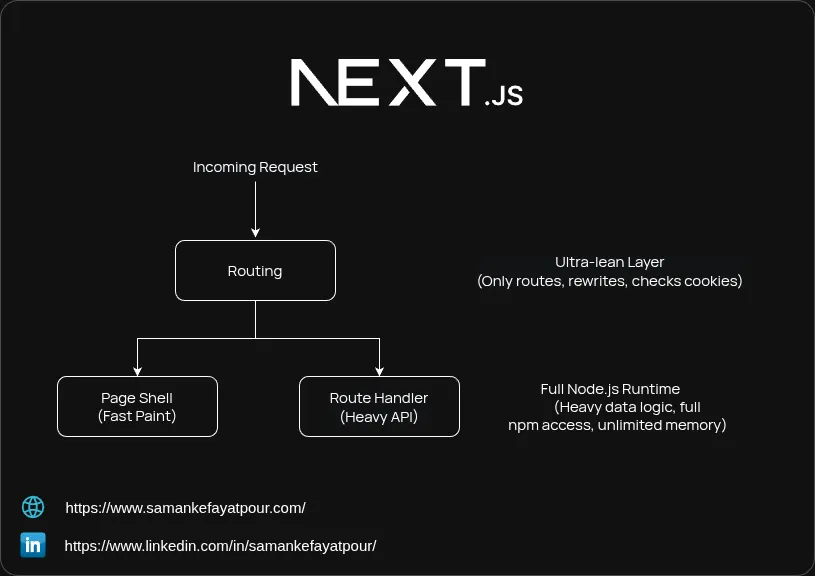
The optimal strategy for a resilient architecture is Performance Isolation. Rather than forcing a single file to act as a monolithic gateway, network logic should be clean-cut: ultra-lean infrastructure routing at the gateway boundary, and resource-intensive application workloads safely deferred to the application server layer.
                         [Incoming Request]
                                │
                                ▼
                        ┌───────────────┐
                        │    Proxy      │ ◄─── Ultra-lean Gateway
                        └───────┬───────┘      (Only routes, rewrites, passes headers)
                                │
                ┌───────────────┴───────────────┐
                ▼                               ▼
       ┌────────────────┐              ┌─────────────────┐
       │   Page Shell   │              │  Route Handler  │ ◄─── App Server Environment
       │  (Fast Paint)  │              │   (Heavy API)   │      (Heavy data logic, full
       └────────────────┘              └─────────────────┘      database connection pools)
When initial routing remains lean, runtime exceptions or sudden traffic spikes on an intensive API endpoint stay entirely isolated to that specific Node.js thread or container instance. The core navigation layer and initial static paint of your frontend application remain completely unaffected.
Because proxy.ts provides unrestricted access to the Node.js environment, we must be incredibly disciplined about drawing boundaries based on critical path optimization:
| Architectural Concern | Primary Location | Why It Belongs There |
|---|---|---|
| Global Redirects & Rewrites | next.config.ts | Zero-compute overhead; evaluated at the platform configuration layer before any server-side code executes. |
| Dynamic / Conditional Routing | proxy.ts | Perfect for low-latency routing decisions based on active cookies, incoming headers, or multi-zone path shaping. |
| Geographic Optimization | proxy.ts | Reads zero-compute platform headers (x-vercel-ip-*) to branch and rewrite paths instantly. |
| Session & Auth Token Validation | Server Components / Functions | Never rely on Proxy alone for security. A simple path refactor or inline Server Action can cause a route to bypass the proxy matcher entirely, creating silent security holes. |
| Database Queries & Mutations | Server Components / Actions | Keeps heavy data fetching, connection handshakes, and object-relational mapping (ORM) strictly bound to the rendering lifecycle. |
| Heavy Compute & Transformations | Dedicated Node.js Route Handlers | Prevents request-blocking and separates massive payload processing from the user-facing page delivery pipeline. |
Relying on proxy.ts as an absolute web application firewall is a dangerous production anti-pattern. Because proxy execution is bound strictly to path matching configurations (config.matcher), your application's security posture becomes dangerously coupled to directory naming conventions.
If a developer renames a backend endpoint from /api/dashboard to /api/v2/dashboard, or triggers an inline Server Action that compiles to an internal framework route, that request will silently bypass the proxy rules entirely. Next.js design principles dictate that while you can perform an optimistic check at the proxy level (such as verifying cookie presence), hard authentication and authorization must be re-verified inside each individual Server Function or Route Handler where the actual data exposure occurs.
By stripping heavy logic out of your global files, you free up the compute capacity needed to handle infrastructure tasks like secure gateway routing and geographic personalization cleanly and efficiently.
Using proxy.ts inside a web framework does not replace a dedicated infrastructure-level reverse proxy like Nginx or AWS CloudFront. Those infrastructure systems manage low-level TCP/TLS termination, rate-limiting fires, and DDoS protection at the network edge. A Next.js proxy acts as an application-level programmatic boundary (a Backend-for-Frontend gateway) to shape, inspect, and enrich incoming traffic before it hits your page routing mechanics.
For full-stack applications communicating with private virtual private clouds (VPCs) or distinct cloud clusters, an application proxy handles secure request modification effortlessly. The client interacts exclusively with a clean public endpoint, keeping internal microservice topologies safely hidden away.
Furthermore, if downstream microservices require master administrative credentials or private keys (X-API-KEY), passing them to a client browser is out of the question. Instead, the proxy layer acts as a secure boundary, verifying the presence of a client session cookie and embedding the necessary private tokens right as the request leaves the public internet.
import { NextResponse } from 'next/server';
import type { NextRequest } from 'next/server';

export function proxy(request: NextRequest) {
  const { pathname } = request.nextUrl;

  // Isolate the proxy route to avoid intercepting global static assets
  if (pathname.startsWith('/api/v1/checkout')) {
    const internalVpcUrl = new URL(
      pathname,
      'https://internal-load-balancer-9823.ec2.internal'
    );

    const forwardResponse = NextResponse.rewrite(internalVpcUrl);

    // Inject private environment variables at the network boundary
    forwardResponse.headers.set(
      'X-Internal-Api-Key',
      process.env.INTERNAL_SERVICE_SECRET || ''
    );

    return forwardResponse;
  }

  return NextResponse.next();
}

export const config = {
  // Scopes the proxy to target paths, saving global compute cycles
  matcher: '/api/v1/checkout/:path*',
};
When deploying on specialized edge networks like Vercel, infrastructure headers provide critical context automatically. This allows applications to capture geographic and security metadata with zero computational overhead, removing the need for heavy, third-party geolocation or threat-analysis libraries.
export function proxy(request: NextRequest) {
  // Capture geo data natively provided by the platform infrastructure
  const country = request.headers.get('x-vercel-ip-country') || 'US';

  if (country === 'UK') {
    return NextResponse.rewrite(new URL('/uk-distribution-hub', request.url));
  }

  return NextResponse.next();
}
The underlying platform populates several highly optimized geo-headers instantly:
x-vercel-ip-country: Two-letter country code (e.g., US, DE) for structural localization rewrites or compliance geoblocking.x-vercel-ip-country-region: ISO state/region code (e.g., CA) for real-time shipping estimate modifications prior to rendering.x-vercel-ip-city: Origin city name (e.g., Berlin) to instantly populate local dashboards or contextual widgets.x-vercel-ja4-digest: Client TLS handshake fingerprint for low-impact bot mitigation and proactive threat intelligence.While offloading heavy logic to Node.js Route Handlers resolves API compatibility and memory constraints, serverless deployments introduce their own hard ceiling: execution timeouts and protocol restrictions.
When code is deployed as a serverless function (such as managed instances on Vercel or AWS Lambda), execution windows are bound by rigid duration caps tied directly to your infrastructure tier.
If an application requires operations that exceed these platform-enforced windows—such as heavy video transcoding, generating massive asynchronous data exports, or waiting on prolonged third-party webhooks—relying on a standard Route Handler will result in an automatic gateway timeout error.
When dealing with long-running tasks, developers often attempt to use real-time streaming to update the client on progress. However, standard serverless architectures place severe restrictions on these protocols:
ReadableStream targets, an SSE connection hosted inside a serverless function is still bound by the maximum gateway timeout limit. If the underlying background task takes 20 minutes, the serverless function hosting the SSE stream will timeout and terminate mid-stream.For truly prolonged operations, architectural components must shift entirely away from the request-response model toward asynchronous worker models, utilizing external message queues (like SQS or Upstash) alongside decoupling platforms to run background jobs outside the web application lifecycle.
The evolution of modern web frameworks emphasizes explicit architectural intent over implicit framework magic. By keeping the global proxy layer thin, performant, and focused strictly on distributed routing coordination, full-stack systems become easier to debug, secure by default, and highly isolated against performance regressions.
As always, if you have any questions or suggestions, please feel free to share them with me. If you know a better approach, I’d love to hear about it. I’m always open to learning and improving my knowledge!
Stay humble and keep learning!